
Quick SummaryEmergency roof replacement in Chicago applies when active water intrusion, hail bruising, or storm damage threatens a home’s safety and integrity. A prompt call, careful on-site assessment, and thorough documentation for insurance purposes protect the property while a full, lasting replacement plan is put together. Storm events often affect gutters and decking alongside the roof, so addressing everything together saves time. Choosing a local, responsive crew that handles full replacements rather than piecemeal patch jobs, and understands the insurance claims process without promising specific outcomes, makes a stressful situation considerably more manageable for homeowners. |
A storm rolls through, hail hammers the roofline, and suddenly there is a wet stain spreading across your ceiling. In that moment, most homeowners have the same question: is this serious enough to call someone right now, or can it wait until morning? Knowing the answer, and knowing who to call, makes a real difference in how much damage your home ends up with.
Emergency roof replacement in Chicago is less about a quick patch and more about getting the right crew out fast to assess the damage and get a full, lasting fix underway.
What Actually Counts as a Roofing Emergency
Not every roof problem needs an urgent call at midnight, but certain situations should never wait:
- Active water intrusion inside the home, especially near electrical fixtures or wiring
- Visible hail bruising or missing shingles across large sections of the roof after a storm
- A fallen tree limb that has damaged a section of the roofline
- Visible sagging in the roofline, which can indicate deeper structural concern
If you are seeing any of these signs, the priority is stopping further water intrusion and getting a proper assessment scheduled quickly.
Why a Fast, Full Response Matters
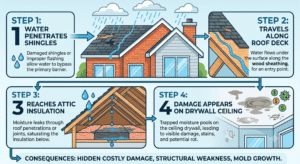
Water does not stay contained. Once it gets past the shingles, it travels along the deck, drips into insulation, and eventually reaches drywall, framing, and electrical systems.
That is why we treat these calls seriously and move quickly, not with a single technician sent out to slap on a tarp and disappear, but with a full crew ready to assess the damage properly and move straight into a complete fix if that is what the roof needs.
What to Expect When You Call Us
Step 1: Initial Phone Assessment
We ask specific questions about the type of damage, whether water is actively entering the home, and how the storm affected the surrounding area. This helps us prioritize the response and get the right crew scheduled.
Step 2: On-Site Assessment
Our team inspects the roof in person, checking not just the obvious damage but the surrounding areas where hail bruising or wind lift often hides.
Step 3: Documentation for Insurance
Photos and notes are taken during the assessment to support an insurance claim if the damage stems from a covered event like hail. Through our sister public-adjusting company, we can help walk homeowners through what that process typically looks like, though we never guarantee a specific claim outcome or promise that every inspection will find qualifying damage.
Step 4: Full Roof Replacement
When the assessment shows the roof needs it, we move forward with a complete replacement. Our crews are built around doing this well the first time, which is a big part of why our work holds up for decades rather than seasons.
Storm Damage and Insurance Claims
Much of what qualifies as an emergency stems from hail damage, which can bruise shingles in ways that are not always obvious to an untrained eye standing on the ground. Insurance companies typically want a clear timeline of events and solid documentation, which is another reason a prompt, thorough assessment matters.
We are not an out-of-state crew chasing storms through the region. We are based here, and our reputation, close to 250 Google reviews at a 4.9-star average, reflects work we stand behind long after the truck leaves the driveway.
What Not to Do While Waiting for Us
- Do not climb onto a wet or storm-damaged roof yourself. It is far riskier than it looks, especially after hail or wind.
- Do not ignore a small leak assuming it will dry out on its own. Trapped moisture behind drywall or insulation rarely resolves without intervention.
- Do not skip photos before any cleanup begins, since insurers rely heavily on early documentation.
Beyond the Roof: Related Storm Impact
Storm events rarely damage just the roof. Gutters torn loose by wind and hail-battered siding often accompany roof damage in the same event. If your storm hit multiple areas of your property, it is worth having your gutter systems checked alongside the roof, since damaged or clogged gutters can send water pooling against the foundation while the roof work is underway.
If a fallen limb also affected an outdoor structure, a deck damage assessment is worth doing at the same visit rather than scheduling separately later.
How We Handle These Calls
Our team treats every call, whether it is a routine full roof replacement, roof installation requirement, or a storm-driven emergency, with the same level of craftsmanship and the same full crews.
We are BBB accredited, GAF and Owens Corning certified, hold an active Illinois contractor license, and work directly alongside our sister public-adjusting company so property owners are not left managing the insurance process entirely alone.
We have responded with storm damage repair for homeowners in communities including Grayslake and North Chicago, assessing damage quickly and following through with a full, proper replacement once the scope of the work is clear.
Contact our team now for a rapid, honest assessment of what your home needs.
Frequently Asked Questions